


Executive Summary
Artificial intelligence (AI) has become a material capability in modern talent acquisition. Its relevance and application, however, differ significantly between high-volume general recruitment and specialized interim management.
In general recruitment, AI primarily functions as an efficiency engine, automating high-volume screening, sourcing, and administrative tasks to increase scale and speed.
In interim management, AI operates more as a precision and intelligence engine, supporting nuanced matching of senior talent, market insight, and strategic advisory.
This white paper examines the principal use cases, relative impact, and operational implications of AI in both domains. It concludes that while both business models derive substantial value from AI, the optimal deployment strategy and human–AI balance differ according to candidate volume, placement complexity, and relationship intensity.
Introduction
Talent acquisition businesses face persistent pressure to improve speed, quality, and cost-effectiveness of placements while maintaining candidate and client experience.
Artificial intelligence offers proven capabilities in pattern recognition, natural language processing, predictive analytics, and process automation that address these pressures.
Two distinct segments within the broader talent market—general recruitment (permanent and high-volume staffing) and interim management (temporary senior executive and specialist placements)—exhibit different operational characteristics. These differences shape how AI is most effectively applied.
This paper provides a structured comparison of AI utilization in the two segments, based on prevailing industry practice.
AI in General Recruitment
General recruitment is characterized by relatively high candidate volumes, standardized role requirements, and a strong emphasis on throughput. In this environment, AI delivers value primarily through scale and speed.
Principal applications include:
- Automated CV/resume parsing, screening, and ranking against job criteria
- Large-scale candidate sourcing across databases and professional networks
- Chatbot-enabled initial qualification and engagement
- High-volume personalized outreach sequences
- Automated interview scheduling and status management
- Basic predictive models for time-to-hire and offer acceptance probability
The early stages of the recruitment funnel become highly automated, allowing recruiters to concentrate on mid- and late-stage activities such as client management and closing.
Return on investment is typically realized relatively quickly through measurable reductions in screening time and increases in processing capacity.
AI in Interim Management
Interim management involves lower placement volumes, higher individual assignment values, and a focus on senior professionals with specialized leadership or transformation experience.
Matching requirements are multi-dimensional, encompassing technical expertise, leadership style, project track record, and contextual/cultural fit.
In this setting, AI functions predominantly as a decision-support and intelligence layer rather than a high-volume automation tool.
Key applications include:
- Precision matching of senior profiles against complex client briefs
- Analysis and refinement of assignment requirements
- Market intelligence on demand trends, skills availability, and day-rate benchmarks
- Construction and interrogation of internal knowledge bases of past assignments and outcomes
- Predictive assessment of assignment success probability
- Selective, high-quality outreach and administrative support
Human judgment, relationship management, and trust remain central throughout the process. AI enhances the quality and speed of consultant work rather than replacing significant portions of it.
Comparative Analysis
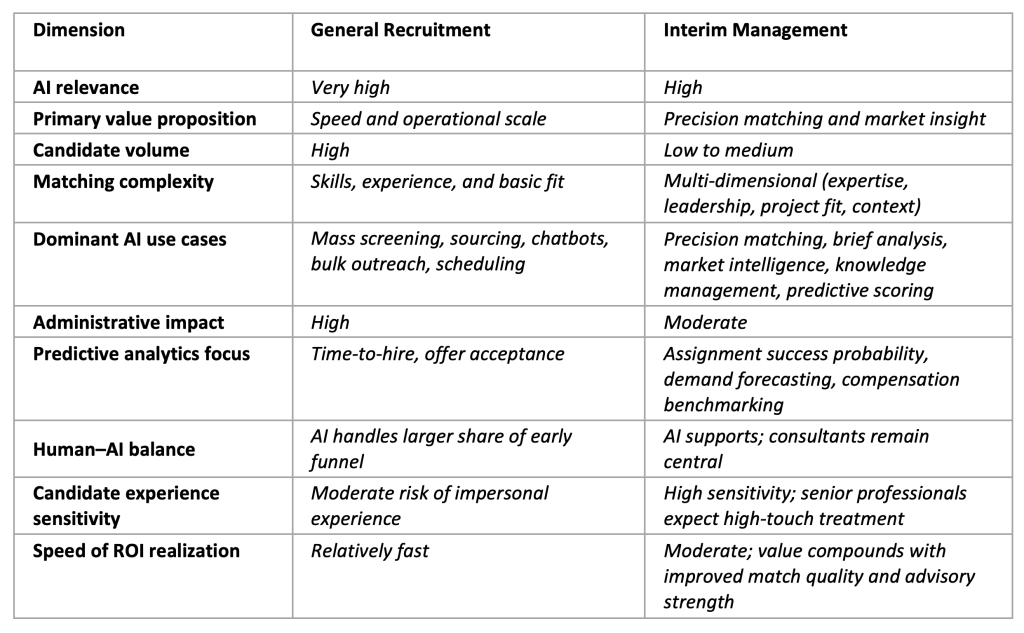
The following table summarizes the principal differences in AI application between the two models:
Implications for Practice
Organizations operating general recruitment models can typically automate a larger proportion of the early recruitment process and should prioritize tools that integrate tightly with applicant tracking systems and deliver measurable throughput gains.
Interim management firms derive greater relative value from capabilities that improve matching accuracy, provide proprietary market insight, and leverage historical placement data. Over-automation carries higher risk because of the seniority of candidates and the relationship-driven nature of the business.
In both cases, successful deployment requires attention to algorithmic bias, data privacy and confidentiality (particularly acute with senior profiles), and the preservation of a high-quality candidate experience.
Conclusion
Artificial intelligence is a high-value capability across both general recruitment and interim management. Its optimal application, however, is not uniform.
General recruitment benefits most from AI as an efficiency and scale engine.
Interim management benefits most from AI as a precision and intelligence engine.
Firms that align their AI strategy with the underlying economics and relationship dynamics of their business model, rather than applying generic automation will capture the greatest competitive advantage. The most effective outcomes in both segments continue to arise from thoughtfully designed human–AI collaboration rather than wholesale replacement of professional judgment.
To know more talk to one of our consultants.